
HPV Vaccination Specialist in Kochi
Protect Against HPV Before It Becomes a Bigger Concern
Protect against HPV-related cancers with expert guidance on HPV vaccination, eligibility and the right vaccination schedule.
Protect against HPV-related cancers with expert guidance on HPV vaccination, eligibility and the right vaccination schedule.
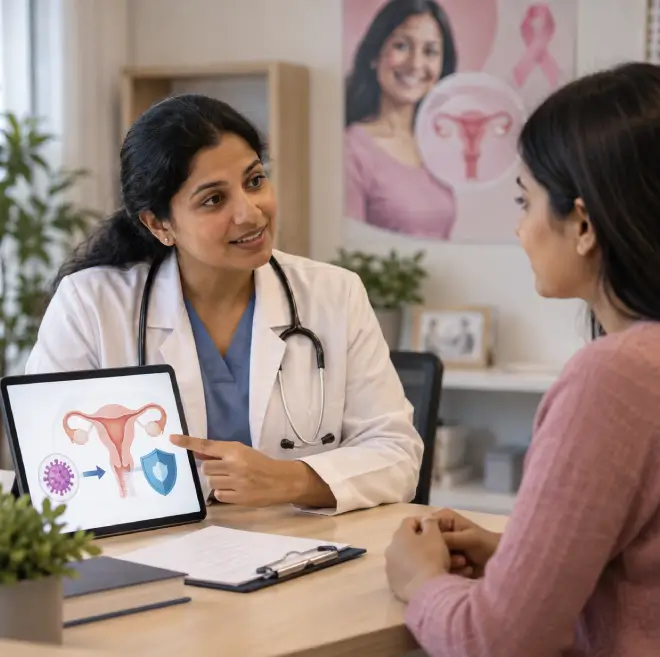
Human papillomavirus, or HPV, is a very common infection and persistent infection with certain high-risk HPV types can lead to cervical cancer. HPV vaccination is one of the most effective ways to prevent HPV-related disease, with vaccination providing the greatest benefit when given before exposure to the virus. WHO recommends HPV vaccination as a key part of cervical cancer prevention, particularly for girls aged 9 to 14 years.
Dr. Priya Bhati provides specialist guidance on HPV vaccination in Kochi, including who should consider vaccination, the appropriate schedule based on age and individual circumstances, and why vaccination does not replace regular cervical cancer screening later in life.
Human papillomavirus, commonly known as HPV, is a group of viruses that can infect the skin and mucous membranes.
HPV infection is extremely common. Many infections cause no symptoms and clear naturally. However, some high-risk HPV infections can persist in the body and cause abnormal changes in cells.
Persistent infection with certain high-risk HPV types can lead to precancerous changes of the cervix. If these changes are not detected and treated, some can eventually progress to cervical cancer.
HPV is also associated with other cancers, including some cancers of the vulva, vagina, anus, penis and throat.
This is why HPV vaccination is not simply a vaccine against one infection. It is an important part of preventing several HPV-related diseases.
Cervical cancer is closely linked to persistent infection with high-risk HPV.
The good news is that cervical cancer is one of the cancers for which prevention is possible at several stages.
HPV vaccination helps prevent new infections with HPV types covered by the vaccine. Cervical cancer screening can identify HPV infection or abnormal cervical cells before cancer develops. Precancerous changes can then be monitored or treated when appropriate.
WHO describes HPV vaccination and cervical screening as key components of cervical cancer prevention.
Vaccination therefore works as part of a larger prevention strategy rather than as a replacement for screening.
The ideal time for HPV vaccination is before exposure to HPV.
WHO identifies girls aged 9 to 14 years as the primary target group for HPV vaccination. The vaccine can provide the greatest preventive benefit when administered before HPV exposure.
In India, the Indian Academy of Pediatrics recommends HPV vaccination for adolescents, with a 2-dose schedule for those who start between 9 and 14 years and a 3-dose schedule for those starting at age 15 or older.
The exact recommendation can depend on age, previous vaccination, immune status and the vaccine being used.
If you are unsure whether your daughter or you should receive the vaccine, a consultation can help clarify the appropriate schedule.
No.
HPV can affect both females and males, and HPV-related cancers and diseases can occur in both sexes.
However, cervical cancer prevention is a major focus of HPV vaccination programmes because persistent high-risk HPV infection is the cause of almost all cervical cancers.
WHO notes that vaccination of secondary groups, including boys and older females, can also be considered where feasible and affordable.
The appropriate age and schedule should be discussed with a healthcare professional based on local recommendations and individual circumstances.
For cervical cancer prevention, vaccination during early adolescence is particularly important.
WHO recommends girls aged 9 to 14 as the primary target group.
One reason for vaccinating at this age is that the vaccine works by preventing new HPV infections. It is most effective when given before exposure to the virus.
Waiting until adulthood does not necessarily mean vaccination is useless. However, the potential benefit can be lower because a person may already have been exposed to one or more HPV types covered by the vaccine.
The decision for older individuals should therefore be based on age, vaccination history and the likelihood of future HPV exposure.
Yes, vaccination may still be considered for some adults who were not vaccinated earlier.
Recommendations differ according to country and age.
For example, current CDC guidance recommends routine vaccination through age 26 for people who were not adequately vaccinated earlier. For adults aged 27 to 45, vaccination is based on shared clinical decision-making rather than being routinely recommended for everyone.
The reason is straightforward. HPV vaccination prevents new infections but does not treat an HPV infection that is already present.
An adult who has already been exposed to some HPV types may still receive protection against other vaccine-covered types they have not encountered.
If you are considering HPV vaccination as an adult, discussing your individual situation with a doctor is more useful than assuming the vaccine is either necessary for everyone or ineffective after adolescence.
The number of doses depends on the age at which vaccination begins and individual circumstances.
According to current IAP guidance in India:
WHO recommendations differ somewhat because WHO allows one- or two-dose schedules for certain age groups, while national and professional recommendations may use different schedules.
For this reason, the vaccination schedule should be confirmed with the treating doctor and based on the vaccine being administered and the applicable local guidance.
A delayed HPV vaccine dose generally does not mean that the entire vaccination series needs to be started again.
The next dose can usually be given according to the appropriate interval.
CDC guidance specifically states that if the HPV vaccination schedule is interrupted, vaccine doses do not need to be repeated.
If you have missed a scheduled dose, bring your previous vaccination record to your consultation. The doctor can determine what dose is required and when it should be given.
HPV vaccination is designed to prevent infection with HPV types that can cause cervical cancer.
It therefore plays an important role in cervical cancer prevention.
However, vaccination cannot prevent every case of cervical cancer because not all high-risk HPV types are necessarily covered by every vaccine, and vaccination may occur after exposure to HPV.
This is why vaccinated women should still follow appropriate cervical cancer screening recommendations.
WHO recommends combining HPV vaccination with cervical cancer screening as part of the overall prevention strategy.
No.
This is one of the most important things to understand before vaccination.
HPV vaccines are preventive vaccines. They help protect against new infection with HPV types covered by the vaccine. They do not clear an HPV infection that is already present or directly treat an existing cervical abnormality.
If you already have a positive HPV test, vaccination may still be discussed because you may not have been exposed to all HPV types covered by the vaccine.
However, vaccination does not replace the follow-up or treatment recommended for your existing HPV infection or cervical abnormality.
Having had HPV does not automatically mean that vaccination is of no value.
HPV includes many different types, and previous infection with one type does not necessarily mean you have been exposed to every type covered by the vaccine.
However, the vaccine does not treat the infection you already have.
Your doctor can discuss whether vaccination may still provide preventive benefit based on your age, previous vaccination and individual circumstances.
Yes.
HPV vaccination does not eliminate the need for cervical cancer screening.
The vaccine protects against important HPV types, but it does not cover every possible cause of cervical cancer. Screening can also identify cervical changes that need further evaluation.
WHO recommends that adult women continue to undergo appropriate cervical cancer screening even when HPV vaccination is available.
This means prevention has two important parts:
Vaccination helps prevent HPV infection.
Screening helps detect HPV-related changes early.
Both have an important role.
Yes.
HPV is associated with several cancers beyond cervical cancer.
Depending on the HPV type and site of infection, HPV can contribute to cancers of the:
HPV vaccination can help reduce the risk of diseases caused by the HPV types included in the vaccine.
The exact protection depends on the vaccine product and the HPV types it covers.
HPV vaccines have been extensively studied and monitored.
WHO reports that data from clinical trials and post-marketing surveillance across different regions support the safety of HPV vaccines.
Like other vaccines, HPV vaccination can cause temporary side effects.
Common reactions can include:
Most reactions are temporary.
Your doctor will review relevant medical history before vaccination and advise you about precautions and what to expect after the injection.
HPV vaccination is generally not recommended during pregnancy.
If a woman discovers that she is pregnant after receiving a dose, current CDC guidance indicates that no intervention is needed because of the inadvertent vaccination. Remaining doses should be postponed until after pregnancy.
Pregnancy testing is not routinely required before HPV vaccination according to CDC guidance.
If you are pregnant or planning pregnancy, discuss the timing of vaccination with your doctor.
There is no established evidence that HPV vaccination causes infertility.
The vaccine is intended to prevent HPV-related disease and does not involve reproductive organs being altered or removed.
For adolescents and young women, concerns about future fertility are understandable. A doctor can discuss the available safety information and answer questions before vaccination.
Preventing HPV-related precancer and cancer can also help protect reproductive health by reducing the risk of developing disease that may later require procedures affecting the cervix or reproductive organs.
Yes, age or marital status alone does not determine whether HPV vaccination is appropriate.
The potential benefit depends more on factors such as age, previous vaccination and possible prior exposure to HPV.
Because HPV vaccination works best before exposure, vaccination earlier in life generally provides greater preventive benefit.
For adults, the decision should be discussed with a doctor rather than based simply on marital status.
An abnormal Pap smear does not mean that you have cervical cancer.
It may indicate changes in cervical cells that require repeat testing, HPV testing, colposcopy or another form of evaluation depending on the result.
HPV vaccination does not treat an existing abnormal Pap smear.
If you have an abnormal screening result, follow-up should be completed according to your doctor's recommendation.
Vaccination can still be discussed separately if you have not previously been vaccinated.
A positive HPV test means that HPV has been detected. It does not automatically mean that you have cancer.
Many HPV infections clear naturally. Persistent high-risk HPV infection is the concern because it can lead to cervical precancer over time.
The next step depends on the HPV type, screening result, age and previous screening history.
If you have a positive HPV result, Dr. Priya Bhati can help assess the result and determine whether further evaluation or follow-up is required.
HPV vaccination may also be discussed if you have not been vaccinated, but it should not be considered treatment for the existing infection.
One common misunderstanding is that receiving the HPV vaccine means cervical screening is no longer necessary.
That is not correct.
HPV vaccination reduces the risk of infection with vaccine-covered HPV types. Screening looks for HPV infection or cervical cell changes that could develop into cancer.
WHO's cervical cancer elimination strategy specifically combines HPV vaccination, screening and treatment as key prevention measures.
For women, preventive care should therefore continue beyond vaccination.
Depending on your age and local recommendations, your doctor can advise when cervical screening should begin and how often it should be repeated.
For parents, the decision to vaccinate a daughter against HPV can bring several questions.
You may wonder:
The recommended vaccination age is intentionally early because the vaccine provides the greatest preventive benefit before exposure to HPV.
WHO identifies girls aged 9 to 14 years as the primary target group.
A consultation can help parents understand the recommendation without confusion or unnecessary worry.
If you have already received one or more HPV vaccine doses, bring your vaccination record to your appointment.
The doctor can review:
You generally do not need to restart an interrupted series simply because there has been a long gap between doses.
The exact next step depends on your previous vaccination history.
Dr. Priya Bhati is an Associate Professor in Gynaecologic Oncology at Amrita Hospital, Kochi, with specialist expertise in gynaecologic cancers and preventive gynaecologic oncology.
Preventive oncology is an important part of gynaecologic cancer care. This includes measures such as HPV vaccination and cervical cancer screening.
For women and parents looking for HPV vaccination guidance in Kochi, a specialist consultation can help answer questions about age, eligibility, previous HPV exposure, vaccination history and the appropriate schedule.
The goal is not simply to administer a vaccine. It is to make sure you understand why it is recommended, what it can prevent and what preventive care you will still need afterwards.
You can consider a consultation if:
Bringing previous vaccination records and cervical screening reports can make the consultation more useful.
1. What is the HPV vaccine?
The HPV vaccine is a preventive vaccine that protects against infection with certain types of human papillomavirus. Some of these HPV types are responsible for cervical cancer and other HPV-related diseases.
2. What age should a girl get the HPV vaccine?
WHO identifies girls aged 9 to 14 years as the primary target group for HPV vaccination.
3. How many HPV vaccine doses are needed in India?
IAP guidance recommends 2 doses for individuals aged 9 to 14 years and 3 doses for those starting vaccination at age 15 or older. Immunocompromised individuals are recommended to receive 3 doses.
4. Can adults get the HPV vaccine?
Some adults can still benefit from vaccination. The recommendation depends on age and individual circumstances. For adults aged 27 to 45, CDC guidance uses shared clinical decision-making rather than recommending routine vaccination for everyone.
5. Can I get the HPV vaccine if I am married?
Marital status itself does not determine whether HPV vaccination is appropriate. Age, previous vaccination and potential prior HPV exposure are more relevant when discussing vaccination.
6. Does the HPV vaccine treat HPV?
No. HPV vaccines prevent new infections with HPV types covered by the vaccine. They do not treat an existing HPV infection.
7. Can I take the HPV vaccine if I already have HPV?
You may still discuss vaccination with your doctor. Previous infection with one HPV type does not necessarily mean you have been exposed to every type covered by the vaccine. However, the vaccine will not clear your existing infection.
8. Do I still need a Pap smear after HPV vaccination?
Yes. HPV vaccination does not replace cervical cancer screening. Vaccinated women should continue screening according to recommended guidelines.
9. Is HPV vaccination safe?
HPV vaccines have a strong safety record, with safety monitored through clinical trials and post-marketing surveillance.
10. What are the common side effects of HPV vaccination?
Common reactions can include pain or swelling at the injection site, mild fever, headache, tiredness or dizziness. These reactions are generally temporary.
11. Can HPV vaccination cause infertility?
There is no established evidence that HPV vaccination causes infertility. If you have concerns about fertility or future pregnancy, discuss them with your doctor before vaccination.
12. Can HPV vaccine be given during pregnancy?
HPV vaccination is not recommended during pregnancy. If a dose is accidentally given during pregnancy, CDC guidance states that no intervention is needed, but remaining doses should be delayed until after pregnancy.
13. Can boys receive the HPV vaccine?
Yes. HPV can affect males as well as females, and vaccination can help prevent HPV-related diseases in both sexes.
14. Can HPV vaccination prevent cervical cancer completely?
No vaccine can prevent every case of cervical cancer. HPV vaccination significantly contributes to prevention, but cervical screening remains necessary.
15. What if I missed my second HPV vaccine dose?
Do not assume that you need to restart the entire series. The appropriate next dose can usually be determined from your vaccination history and the interval since the previous dose.
16. Can I get HPV vaccination after an abnormal Pap smear?
An abnormal Pap smear does not automatically prevent HPV vaccination. However, vaccination does not treat the abnormal result, so recommended follow-up should continue.
17. Can I get HPV vaccination after a positive HPV test?
Vaccination may still be discussed, depending on your age and vaccination history. However, it does not treat the HPV infection already detected.
18. Does HPV vaccination protect against all HPV types?
No. HPV vaccines protect against specific HPV types included in the vaccine. Different vaccines cover different groups of HPV types.
19. Should my daughter get the HPV vaccine even if she is only 9 or 10?
WHO identifies girls aged 9 to 14 as the primary target group for HPV vaccination. The purpose of vaccinating during this period is to provide protection before exposure to HPV.
20. Where can I get HPV vaccination guidance in Kochi?
Dr. Priya Bhati provides specialist gynaecologic oncology care in Kochi, including preventive gynaecologic oncology. A consultation can help you understand whether HPV vaccination is appropriate and which schedule applies to you.

MBBS, M. Ch. (Gynaecologic Oncology), MD (Obs & Gynae)
Senior Consultant - Gynae Oncologist and Robotic Surgeon, Department of Gynecologic Oncology, Amrita Institute of Medical Sciences, Kochi, Kerala
Dr. Priya Bhati is a Senior Consultant Gynae Oncologist and Robotic Surgeon at Amrita Institute of Medical Sciences, Kochi. She specialises in the treatment of gynaecological cancers and complex gynaecological conditions, with expertise in cancer surgery, robotic-assisted surgery and laparoscopic surgery. With years of experience at leading institutions such as CMC Vellore and PGIMER Chandigarh, she brings extensive surgical experience along with a caring and patient-focused approach.
Dr. Priya has completed her M.B.B.S. from Kasturba Medical College, Mangalore, M.D. in Obstetrics & Gynecology from Goa Medical College, and M.Ch. in Gynaecologic Oncology from Christian Medical College, Vellore. She treats women with different types of gynaecological cancers and also performs complex benign gynaecological surgeries and advanced procedures such as CRS and HIPEC.
She believes that every patient deserves to understand her condition and treatment clearly. Along with treating gynaecological cancers, Dr. Priya also focuses on prevention and early detection, including HPV vaccination and preventive gynaecologic care. Her goal is to provide personalised treatment while making patients and their families feel informed, comfortable and supported throughout their care.
I was very scared when I came to know about my cancer. Dr. Priya Bhati explained everything clearly and told me what we should do next. I am really thankful for her support.
Dr. Bhati is very patient and listens to all your doubts. She explained my reports in simple words and did not make me feel rushed. I felt much better after talking to her.
We met Dr. Priya Bhati for my mother’s treatment. She explained the surgery properly and answered all our questions. We felt that she really understood our concerns.
I was worried about having surgery, but Dr. Bhati explained the procedure and what to expect. She was very calm and supportive. I am happy that we consulted her.
Dr. Bhati gave us enough time during the consultation and explained the treatment options clearly. She also listened to what we wanted to know. Very good doctor and a very positive experience.
After my diagnosis, I was confused about what to do next. Dr. Bhati went through my reports and explained everything step by step. Her guidance gave me confidence to start my treatment.